Getting Started
Psychometric traits traffic lights — Portrait Docs
Once you have created several correlation matrices for different purposes, you will have several psychometric traits traffic lights, with a situation similar to the one shown in the image below:
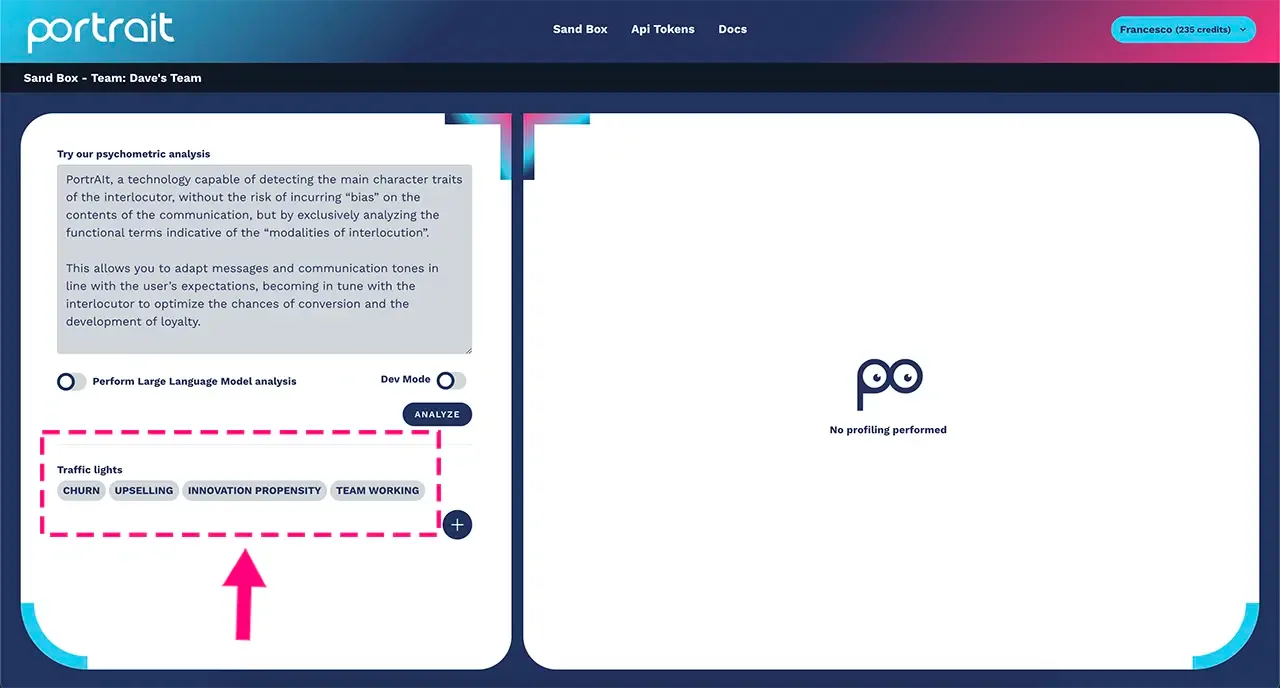
From this moment on, every time you launch a psychometric profiling through the sandbox, the system will check for the presence of the traffic lights of the psychometric traits present in your correlation matrices.
If the traits are present, the traffic light will turn green, as shown in the figure:
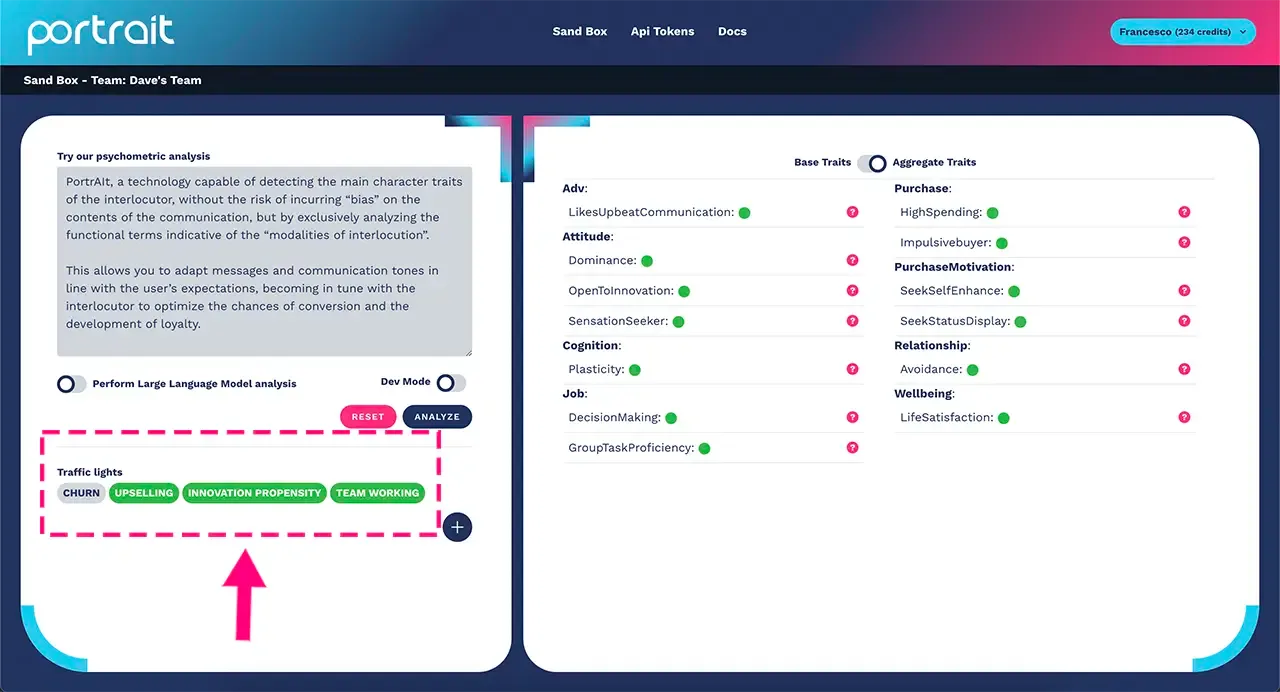
In this case, we see that the analyzed user is inclined to use innovative technology and has good team working skills. Moreover, this is not a user prone to changing supplier easily, because the churn traffic light stays off (grey). The upselling traffic light also stays grey (inactive): this signals that it is unlikely that upselling activities will succeed during a conversation or call with this user.
Examples of psychometric traits to use in traffic lights
- net_transitivity: an individual who has many connections and friendships who know one another, creating a densely interconnected network.
- behav_spendingattitude: a person who is frugal and saves money or, conversely, who is inclined to spend freely.
- pers_openness: detects an individual's willingness to accept new ideas, experiences and points of view.
- pers_anger: a person who becomes angry easily in stressful or provocative situations.
- pers_conscientiousness: a person who is very organized, meticulous and detail-oriented in their activities.
These are just some of the traits that can be analyzed. Go to the chapter dedicated to basic psychometric traits to learn about all the characteristics in detail.
NB: if you use Portrait's psychometric profiling technology integrated into your systems, the value of the traffic lights (and of all detected psychometric traits) will be sent to you in the call output as a JSON value. Once you receive the value, you can decide how to adapt your strategy.